
Info
 Home Page Articles Software Goodies
Explanations
How do they do that? The Web in FocusResources
Web Site Stuff Tech Books E-Books Tech Toys Web Hosting LinksWomen
Opinion Tech Women Women's StudiesTech News
Computer Security Databases Java Linux MP3 PC Software Robotics Site Owner Tech Latest Web Development XMLSpread the Word
Newsletter
Recommend this Page
Site Info
Legal Disclaimer
Privacy
Contact
Lighter Side
Crazy for Life crazy for romance Crazy for Kitties Crazy for Dogs Crazy for CowsCopyright 2000-2001, hertechnology.com
The Internet
You're sitting in Washington, DC, and you access a site in Seattle, Washington. Or you are in California getting data from a web site in Florida. How does the information travel from one place to the other?
As you can imagine, this is a huge and complex topic. To pare it down to a manageable size, I'm going to concentrate on just the flow of information that makes up this gizmo we call the Internet. And, even this is an amazingly complicated mix of different technologies, devices, vendors...whew! Confusion abounds, but we can at least sift the data and pull out some large nuggets of information.
The first point to grasp is revealed in the actual name of the Internet -- "inter" and "net" which means "interconnected" "networks". That is, the Internet shouldn't be thought of as a bunch of computers connected together, but rather as bunches of bunches -- a network of networks.
This situation arose because of how the Internet developed. I'm not going to discuss the Internet's history here. But in the early days, various organizations, like universities, each had their own bunch of computers connected together in their own, separate networks. In the mid-1980's the National Science Foundation funded a development effort to allow universities to connect to various supercomputers. These universities, which already had their own networks, ended up being connected together as a network of networks over the first backbone.
Backbone? What's that? A backbone is a high-speed, large capacity path for data to travel over, connecting one or more locations that are spread apart geographically. As technology has improved, the speed and capacity has increased.
The idea of a data path is the second point to grasp. The information you want to see has to travel over something to get to you, and that something is generally a type of cable -- telephone lines, fiber optic, whatever. A backbone is a special class of data path because of its speed and capacity and because it crosses larger distances.
The third point to get a handle on is the idea of connecting data paths together. Think of a subway system. Certain stations connect two or more subway lines where passengers can get off one line and transfer to another line. Information on its way to you will start down one path, arrive at one of these transfer stations and be directed down the next path to move it closer to you.
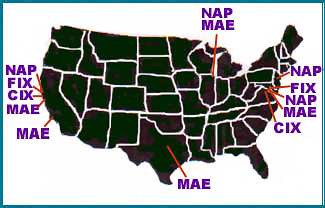
The original, NSF-funded, backbone started with just 13 sites connected to it. As more and more networks started connecting to the backbone (with increasing congestion) and as the commercial potential of the Internet grew, the NSF got out of the backbone business. Also, because of the congestion of the original backbone, planners recognized the need for several connection points -- several places around the country where data paths could be connected. Four places, called Network Access Points (NAPs) were decided upon. In the meantime, a company called Metropolitan Fiber Systems (MFS, which has since been acquired) created four other access points called Metropolitan Area Exchanges (MAEs) where data paths could come together. And, even during the days of the NFS backbone, a couple of commercial sites were created where connections could be made, one in Santa Clara, California, and one in Herndon, Virginia (CIXs). Finally, the US Federal goverment has a couple of its own "transfer" stations (FIXs) that allow government employees access to the Internet. The NAPs are located in San Francisco, Chicago, Washington DC, and Pennsauken, New Jersey. The MAEs are in San Jose (MAE-West), Los Angeles (MAE-LA), Dallas (MAE-Dallas), Chicago (MAE-Chicago), and Washington DC (MAE-East). The two Federal Internet Exchanges are FIX-East (University of Maryland at College Park) and FIX-West (NASA Ames Research Center in California).
Want to bookmark this site? Press
Control-D. (Hold down the control key and the letter D at the same time.)